Edit the SCORM settings
Change the name, description, display, availability, grading and attempts of a SCORM package.
The settings of a SCORM package are in the same form you used to add it. You open the form from the course, change what you need and save. The form has these blocks: General, Package, Appearance, Availability, Grade, Attempts management, Compatibility settings, Restrict access and Completion conditions. Every setting has a default, so you only change what you need.
Open the settings
Click Courses in the menu and then Manage content for the course. In the row of the package, click the pencil icon, the first of the three buttons on the right.
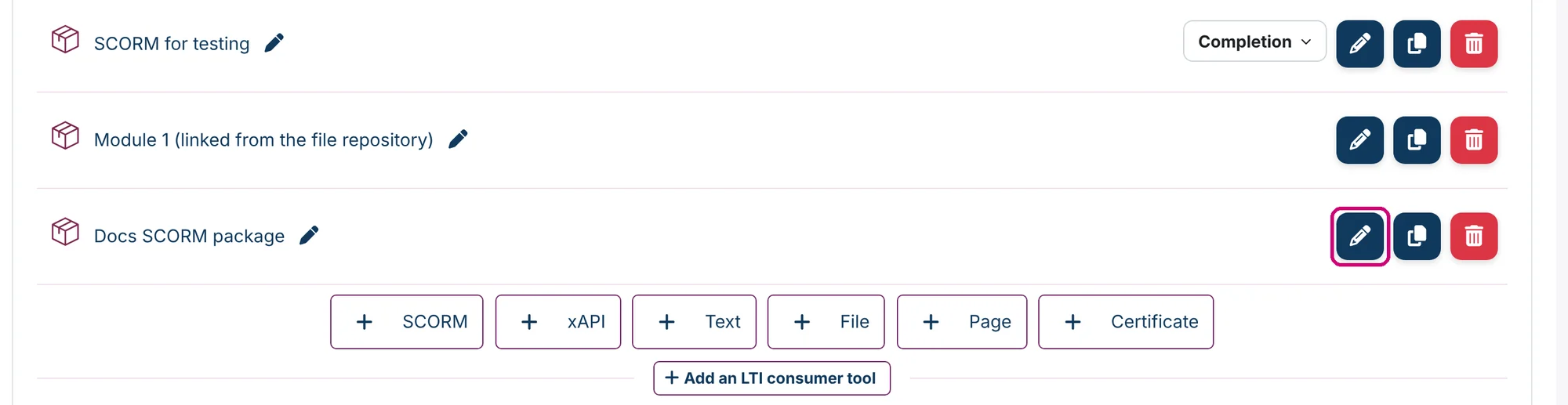
The blocks General and Package are open. Click the heading of a block to open it.
General
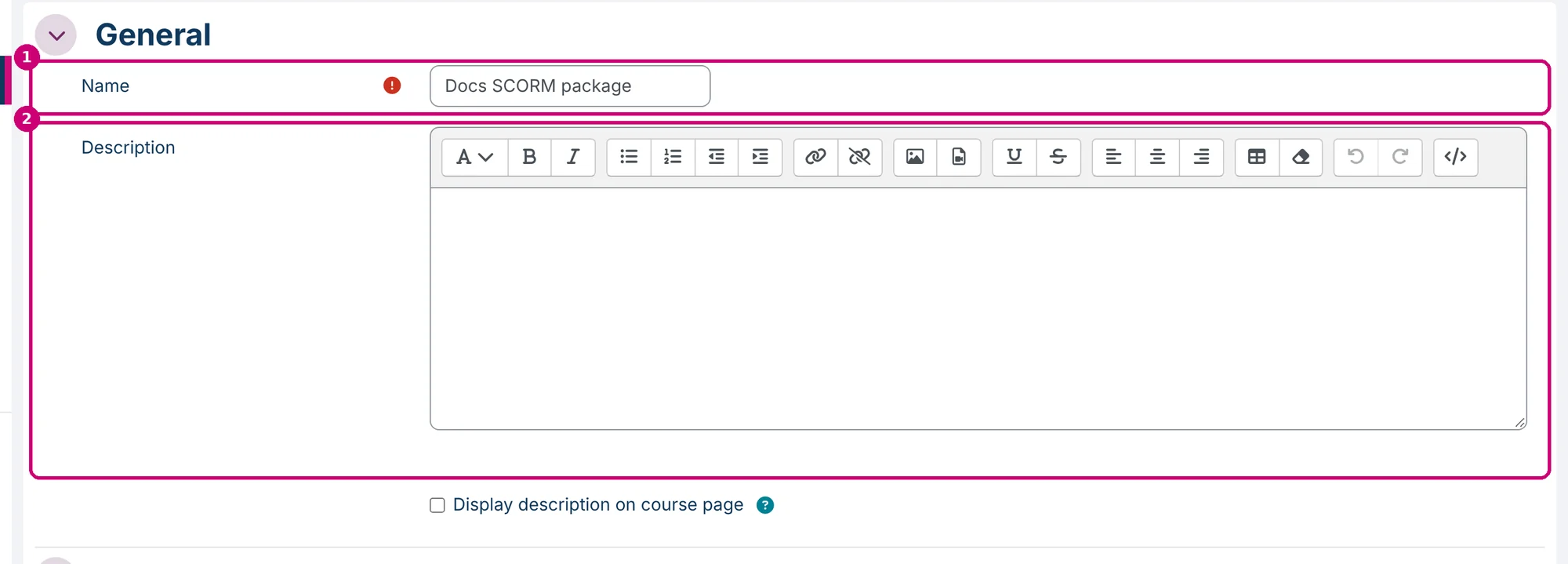
Name (1) is the name learners see in the course. Description (2) is optional. Tick Display description on course page to show it under the name in the course.
Package
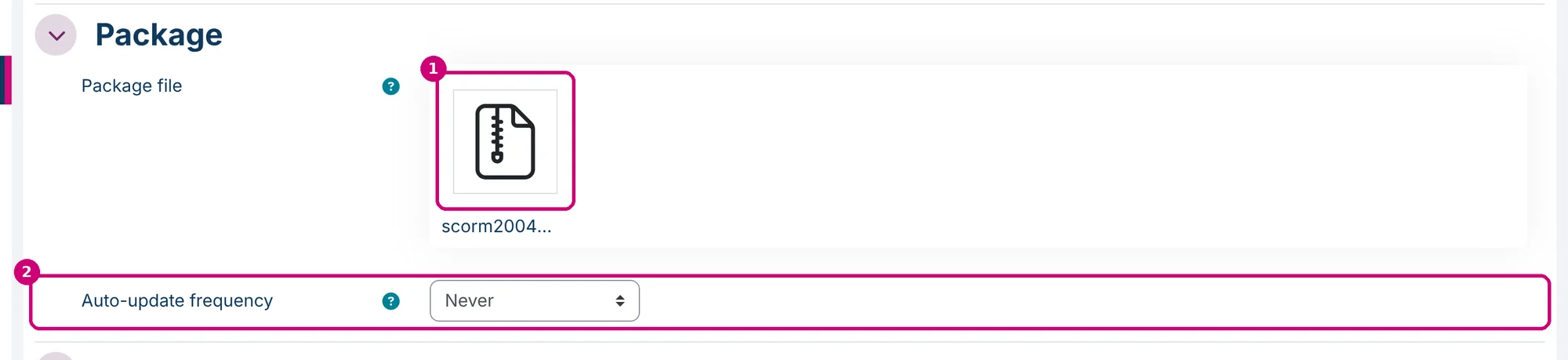
Package file (1) holds the zip file. To replace it with a new version, click the file, delete it and upload the new one, as described in update a SCORM package. If the package is linked from the file repository, don’t delete it here. Upload a new version in the file repository instead, see upload a new version.
Auto-update frequency (2) is set to Never by default. The other options are Every day and Every time it’s used.
Appearance
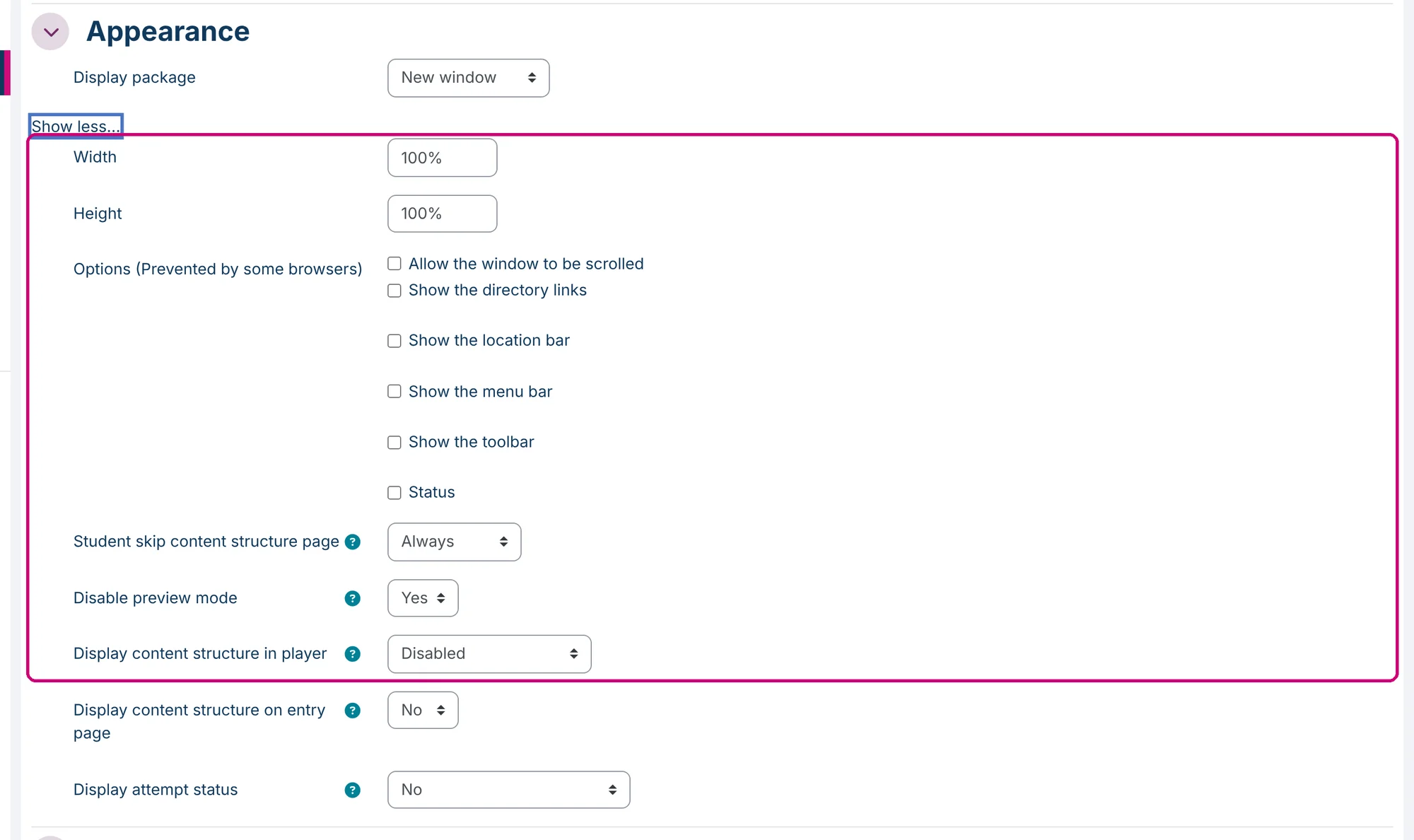
| Setting | Options | What it does |
|---|---|---|
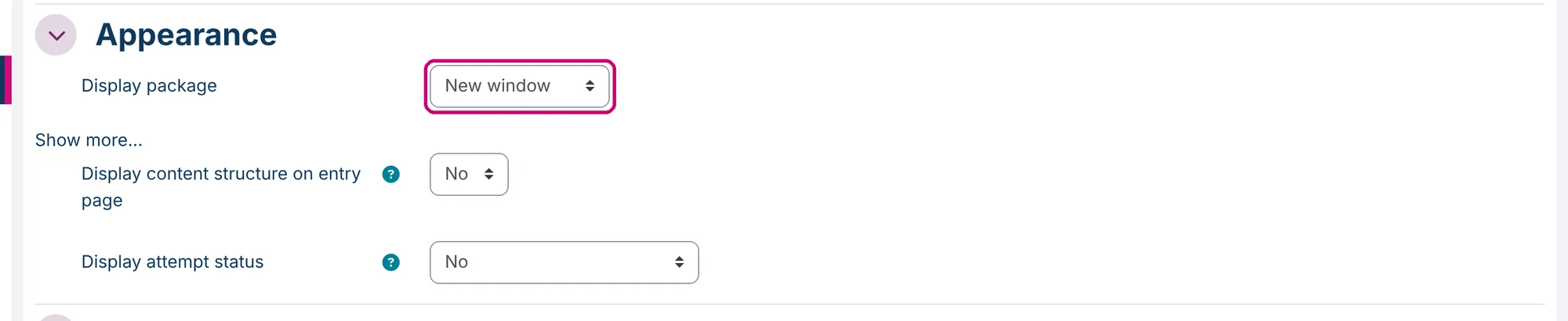
| Display package (1) | Current window, New window | Where the package opens for the learner. |
| Display content structure on entry page (2) | No, Yes | Shows the table of contents of the package on its entry page. |
| Display attempt status (3) | No, Dashboard and entry page, Dashboard only, Entry page only | Shows the learner a summary of their attempts. |
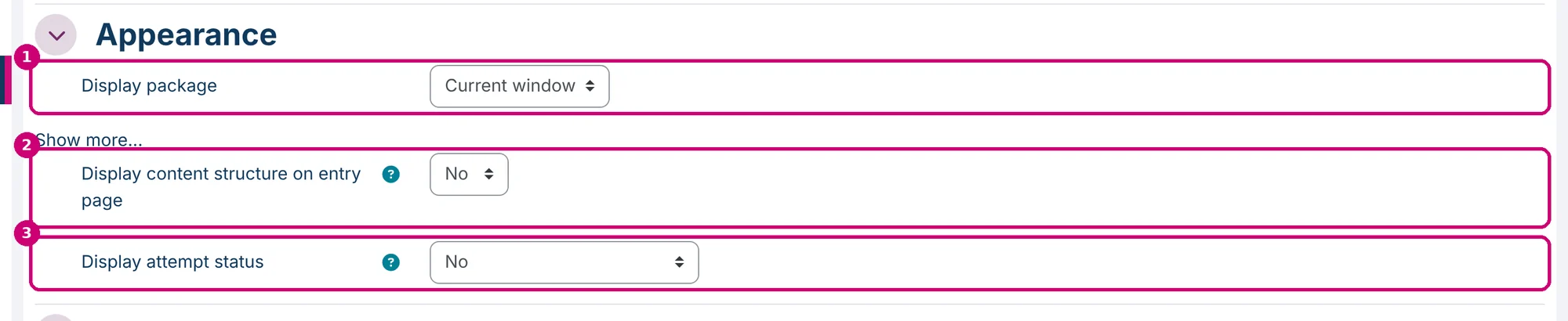
Click Show more… for the remaining settings: Width, Height and the window Options for a package in a new window, Student skip content structure page, Disable preview mode and Display content structure in player. The question mark next to a field explains it.
Availability
Tick Enable next to Available from (1) or Available to (2) and set the date and time. Learners can only open the package in that period.
This block only sets the period. Conditions such as “first complete chapter 1” go through Restrict access, see restrict access to sections and activities.

Grade
Grading method sets how the grade for one attempt is determined:
- Completion status: the number of completed or passed learning objects.
- Highest grade: the highest score of all passed learning objects.
- Average grade: the mean of all scores.
- Sum grade: the sum of all scores.

Grading sets the score. The progress your learners see comes from the completion settings, see how to set up course and activity completion.
Attempts management
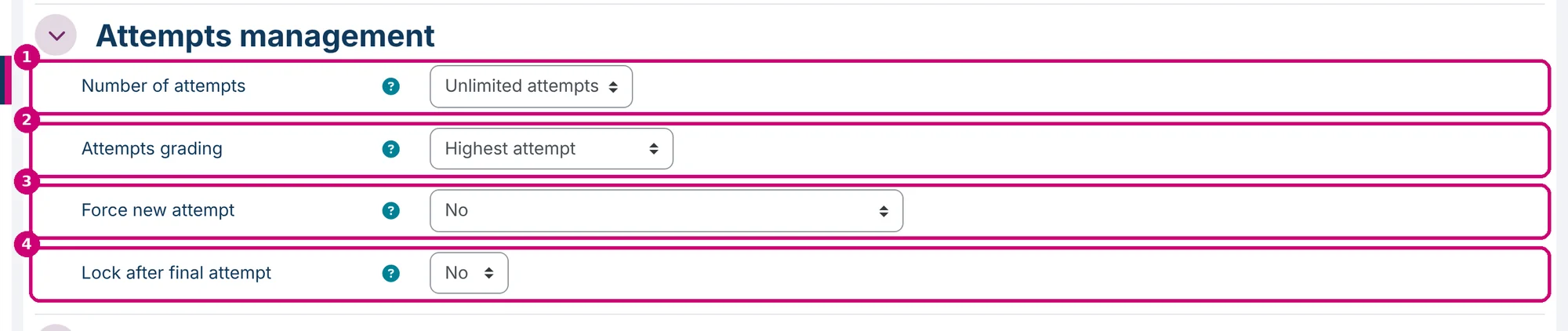
| Setting | Options | What it does |
|---|---|---|
| Number of attempts (1) | Unlimited attempts, 1 to 6 attempts | Limits the number of attempts. Only applies to SCORM 1.2 and AICC packages. |
| Attempts grading (2) | Highest attempt, Average attempts, First attempt, Last completed attempt | Which attempt goes to the gradebook when more than one attempt is allowed. |
| Force new attempt (3) | No, When previous attempt completed passed or failed, Always | Whether a learner who opens the package again starts a new attempt or reviews the previous one. |
| Lock after final attempt (4) | No, Yes | With Yes, a learner can’t open the package after using all attempts. |
Compatibility settings
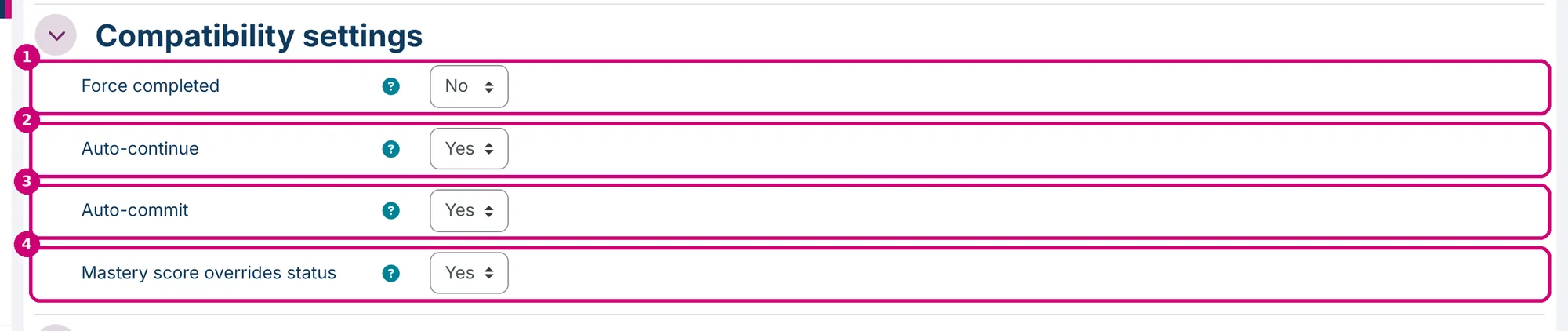
| Setting | Options | What it does |
|---|---|---|
| Force completed (1) | No, Yes | Sets the status of the current attempt to completed. SCORM 1.2 packages only. |
| Auto-continue (2) | No, Yes | With Yes, the next learning object starts automatically. With No, the learner clicks Continue. |
| Auto-commit (3) | No, Yes | With Yes, Linqur saves the SCORM data automatically. Useful for packages that don’t save their data regularly. |
| Mastery score overrides status (4) | No, Yes | With Yes, the status is recalculated from the learner’s score and the mastery score in the package, and overrides the status the package reports. |
Restrict access and Completion conditions
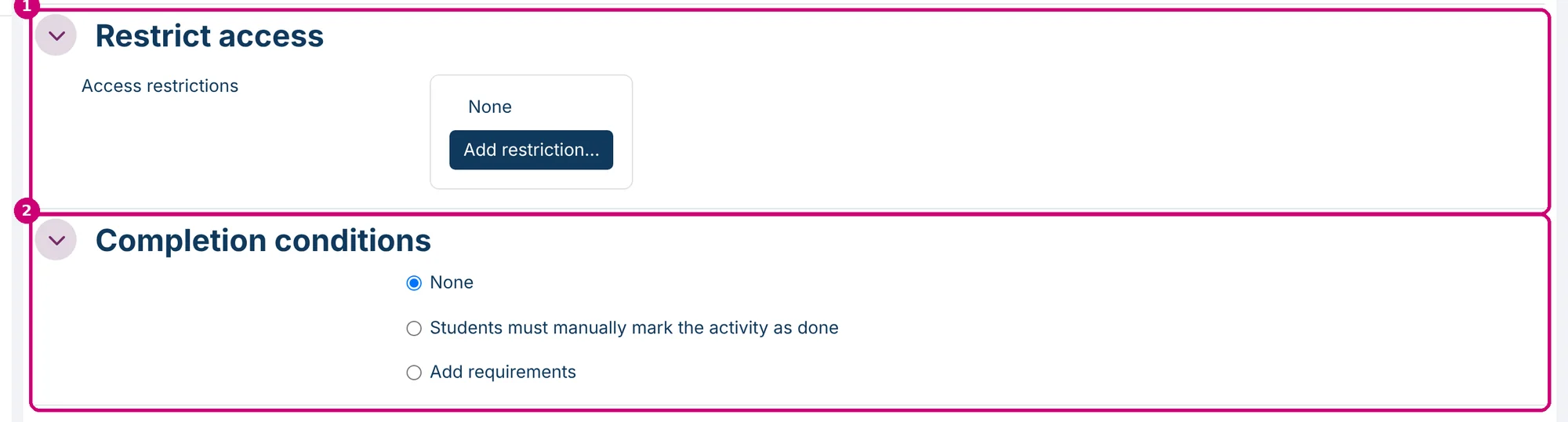
Restrict access (1) sets who can open the package and when, for example after another activity is completed. See restrict access to sections and activities. Completion conditions (2) sets when the package counts as done. See how to set up course and activity completion.
Save
In this example, Display package was changed to New window.
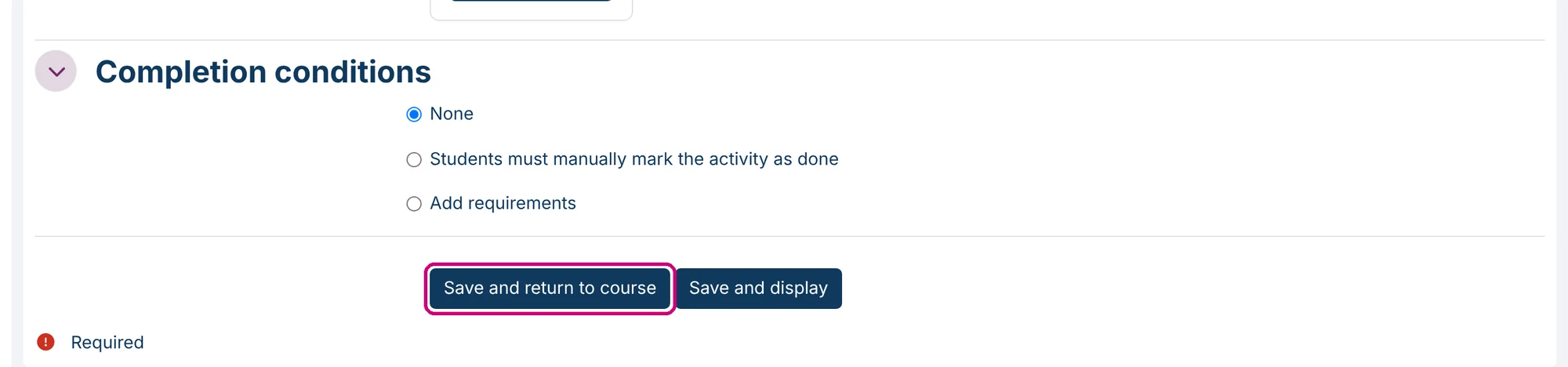
Click Save and return to course, or Save and display to open the page of the package right away.
Next step
- Replace the file with a new version: update a SCORM package.
- Make the package available in your client’s LMS: publish a SCORM package as an LTI tool.