.jpeg)
Every time you update a SCORM package, you face the same problem: tracking down every client, every LMS, and every course instance where that content lives, then manually replacing files across each one. For training companies managing content across dozens of client environments, that process can consume hours of staff time per update cycle, and the risk of version inconsistencies grows with every new deployment.
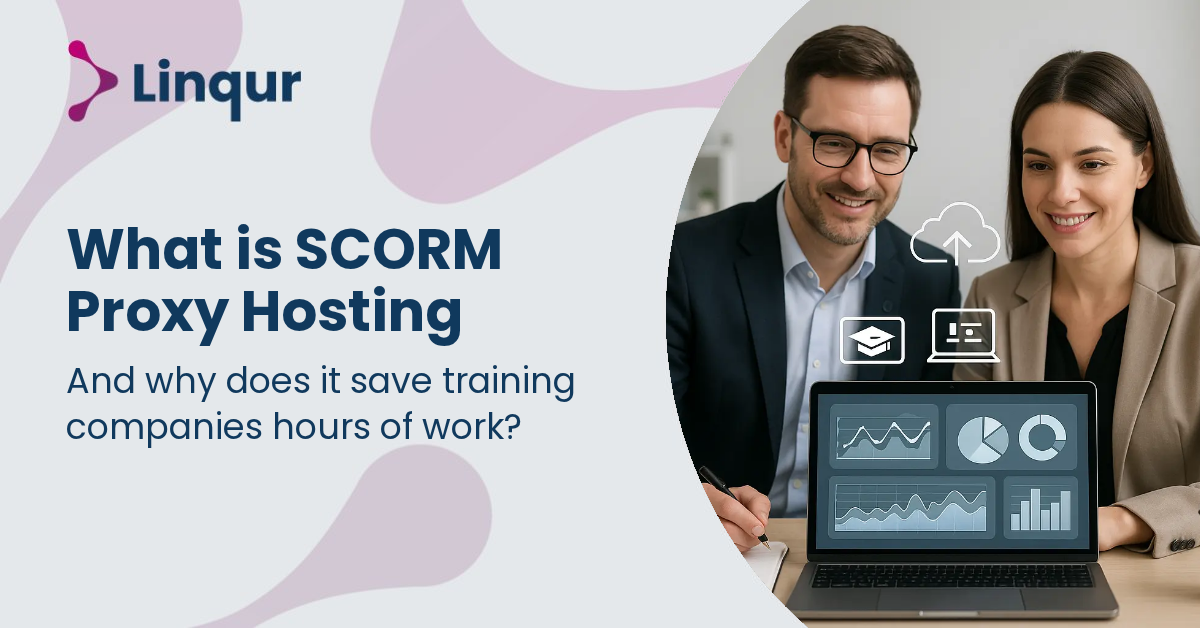
SCORM proxy hosting addresses this directly. Instead of distributing your actual SCORM files to each client's LMS, you host the content centrally and send lightweight proxy packages that point back to your source. When you update the content, the change propagates automatically, without touching a single client system. You stay in control of your intellectual property, your clients get the latest version without any action on their end, and your team avoids the repetitive manual work that comes with traditional SCORM distribution.
If you manage SCORM packages at scale, understanding how proxy hosting works, and where it fits into your content delivery workflow, is important before choosing how to structure your distribution infrastructure.
At a technical level, SCORM content is designed to communicate with an LMS runtime. A standard package can report status, scores, bookmarks, and completion data, but it expects a SCORM-compatible environment to receive and process that information. As iSpring explains in its overview of SCORM hosting, simply uploading a SCORM zip file to general cloud storage or a standard website does not make it function like a learning platform. That gap is where SCORM proxy hosting becomes useful.
With SCORM proxy hosting, the original course remains on a central hosting environment, while the client receives a lightweight proxy or dispatch package that launches the hosted content remotely. SCORM.com describes this model as a compact proxy file, known as a Dispatch Package. In practice, this means you do not need to hand over the full source package every time a customer wants to deploy your course in their LMS.
This matters because many training providers still manage distribution manually. They export a package, send it to a client, answer setup questions, fix version mismatches, resend updated files, and repeat the process for every customer. If you are supporting dozens or hundreds of client LMS environments, that workflow quickly becomes a heavy operational task. Linqur explores this broader issue in its article on managing and updating SCORM packages at scale.
The biggest time saving comes from remote updates. Instead of replacing SCORM files in every customer LMS, you update the hosted master once and let all connected proxy packages deliver the latest version. That removes a large amount of repetitive coordination between your content team, your support team, and each client administrator.
It also changes the support model. Rather than troubleshooting many separate copies of the same course, your team works from one controlled version. When a client reports an issue, you are less likely to discover that they are using an outdated package or a modified local copy. That alone can reduce long email chains and repeated testing across multiple LMS platforms.
Most of the lost time in SCORM distribution comes from predictable tasks:
If you have ever spent days chasing client-side updates for a small wording change or a regulatory correction, you already know why hosted proxy delivery matters. A centrally managed model gives you one place to control content changes, instead of many disconnected copies spread across customer systems. Linqur’s article on SCORM course dispatching at scale shows how quickly this problem grows as distribution volume increases.
In a proxy setup, the learner still launches the course from the client LMS, but the learning content is fetched from the hosting provider rather than stored locally inside the LMS. The proxy package acts as the bridge between the LMS and the remotely hosted course. From the LMS administrator’s point of view, they still import something SCORM-compatible. From your point of view, you retain central control over the actual course files.
That architecture brings several operational advantages. You reduce version fragmentation, limit file duplication, and maintain better oversight of where and how courses are being used. It can also help protect commercial content, because you are not distributing the full course package as freely as in a standard handoff model. The demand for this type of third-party hosting and content control appears in real-world discussions such as this Articulate community thread about dispatching content to users without owning an LMS.
There is also an infrastructure layer behind this that many buyers overlook. If you host centrally, uptime, scaling, security, and proxy-aware delivery all become part of the service design. For example, SCORM Engine guidance on using a proxy or load balancer shows that hosted SCORM delivery often depends on correct forwarding of host and protocol information. Likewise, SCORM Engine scaling guidance highlights the need to scale application servers horizontally as demand grows.
Proxy hosting does not change the learner experience as much as it changes the delivery model behind the scenes. The learner still launches a course from the LMS, but the provider keeps control of the live content and its updates.
SCORM proxy hosting is especially useful if you sell the same course library to multiple organisations, need to keep content updated after deployment, or want to reduce dependence on each client’s technical team. It is also a strong fit if your customers use different LMS platforms and you need a more controlled way to support them.
This model is often attractive for compliance training, partner enablement, franchise networks, and commercial course libraries where the same content is distributed repeatedly. In those cases, the cost of manual packaging and support tends to rise faster than teams expect. A hosted proxy approach can make delivery more repeatable and easier to govern.
You should also think about the broader standards landscape. In some cases, your customers may prefer SCORM versus LTI delivery, depending on how tightly they want the content integrated into their LMS. If you distribute content through more than one technical route, it helps to understand the trade-offs discussed in content distribution with LTI, SCORM, or API.
Before adopting a SCORM proxy hosting model, check four practical points. First, confirm how updates are managed and whether all client instances inherit changes automatically. Second, ask how learner tracking is preserved between the remote content and the client LMS. Third, review hosting and security posture, especially if your customers operate in regulated sectors. Hosted learning infrastructure is not just about convenience, it is also about reliability, and providers such as SCORM Cloud document security and reliability controls for that reason. Fourth, make sure the service matches your commercial model, including content protection, reporting needs, and support processes.
It is also worth asking how the provider handles version rollback, outage response, and compatibility testing across LMS platforms. A proxy model can simplify distribution, but only if the service behind it is stable and well managed. Buyers should understand who is responsible for monitoring, incident handling, and communication when something goes wrong.
If your current process involves repeated exports, repeated emails, and repeated client-side replacements, SCORM proxy hosting can remove a large share of that work. The value is not only in hosting a course online. It is in centralising control so your team stops doing the same deployment job again and again, while clients still receive a SCORM-compatible package that fits their LMS workflow.
Start by mapping how many manual SCORM updates, client exports, and LMS support requests your team handles each month so you can see whether proxy hosting will reduce the workload.
If you want a practical next step, audit one course distribution workflow end to end and identify where centralised control would save your team time and reduce client-side friction.
Joris Even is our founder and the brains behind our products, with 15 years in e-learning. He loves the outdoors and lives to enjoy every moment. Joris’s easy-going approach and deep industry knowledge make our work both fun and impactful.
With our LTI Provider Service, you can integrate your content into any LMS. Fast, simple, and hassle-free. Get the brochure and find out how!
With SCORM Proxy, you can play SCORM courses in any LMS without worrying about updates or hosting. Sounds good? Request the brochure!
Our LTI Converter transforms SCORM into LTI, making your content work in any LMS. Want to know how? Download the brochure and find out for yourself!
With Magic Link Login, your users log in securely with just one click – no passwords, no hassle. Discover how in the brochure!
With the Linqur API, you can seamlessly connect e-learning systems and automate everything. Download the brochure and discover the benefits.