.jpeg)
When you're evaluating platforms to host, deliver, and track your SCORM content, the comparison between Linqur and SCORM Cloud comes up quickly. SCORM Cloud, built by Rustici Software, is a well-established service, but many training providers find that its pricing structure becomes a significant obstacle as their content library or client base grows.
You pay per registration, which means costs scale directly with usage, often in ways that are difficult to predict or control. For course vendors distributing content across multiple client LMS environments, or for L&D teams managing large learner populations, that model can create real budget pressure. Linqur approaches the same problem differently, offering infrastructure-level tools that give you more control over how your content is hosted, shared, and tracked, without tying your costs to learner volume.
Understanding where each platform fits, and where it does not, depends on the specific way your training business operates, the standards you work with, and how you distribute content to your clients or internal audiences.
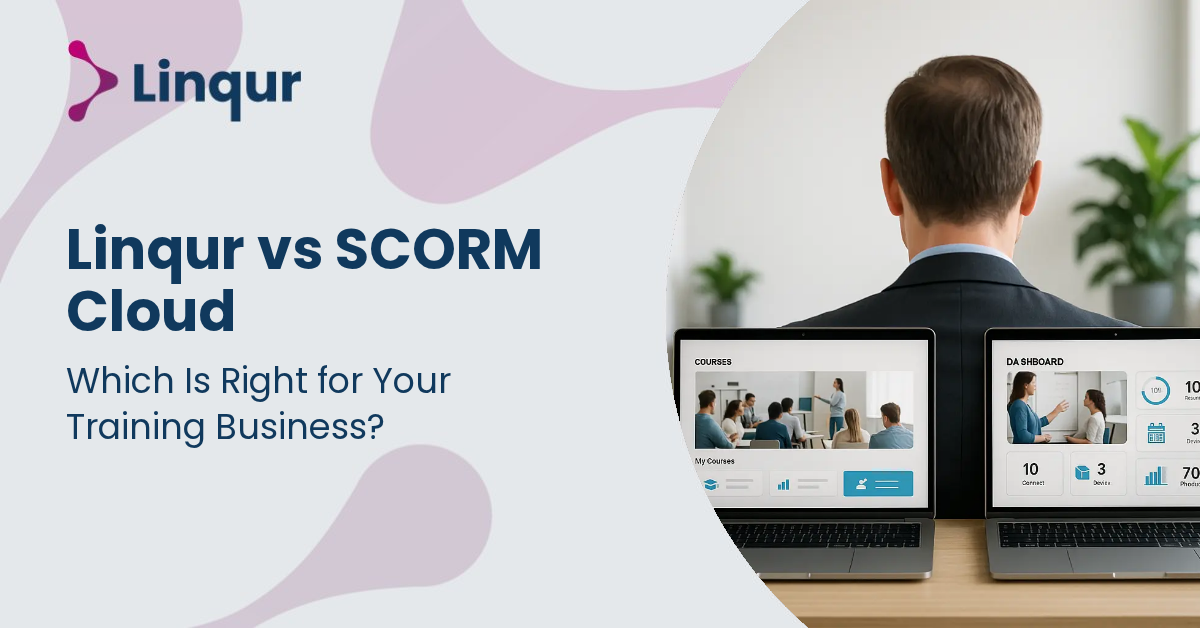
When you compare Linqur vs SCORM Cloud, the biggest difference is not simply who can host a SCORM package. It is how each platform fits into your delivery model, your customer landscape, and the standards you need to support. A traditional SCORM Cloud setup is designed to host and launch SCORM content in the cloud, often as a stand-in for LMS functionality. That works well if your main need is reliable SCORM playback and testing. However, many training businesses now need more than that. They need to distribute content across multiple LMS environments, support external customers, automate provisioning, and maintain control over updates.
That is where the comparison becomes more operational. If your business sells courses to many clients, each with different LMS requirements, you are dealing with an integration problem as much as a content problem. In that scenario, standards such as SCORM, LTI, and direct API workflows matter because they define how content is launched, tracked, and maintained across systems. Linqur’s product set is built around that broader infrastructure layer, while SCORM Cloud is typically evaluated first as a cloud hosting and dispatch environment.
A useful way to assess both options is to separate content hosting from content distribution. Hosting means storing and launching the course somewhere stable. Distribution means getting that course into different client environments without rebuilding your setup each time.
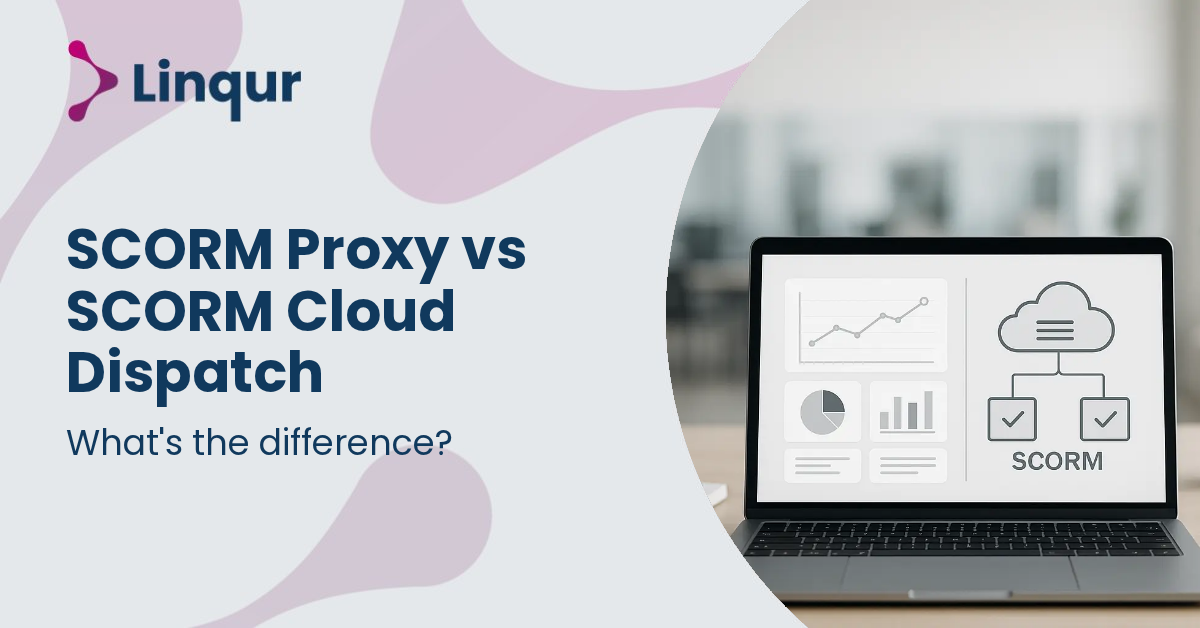
If your main requirement is to upload SCORM files, launch them in a browser, and capture standard completion data, SCORM Cloud can be a reasonable fit. It is widely known for handling SCORM delivery and for acting as an external launch environment. But if you want to push the same course to multiple LMSs, update one master version, and keep control over where and how learners access it, you are moving into proxy, LTI, and API territory. Linqur addresses that model through tools such as the SCORM Proxy and LTI Provider Service. That is also why topics like managing SCORM packages at scale matter so much for vendors serving many customers.
The platform choice changes once you serve multiple organisations. At small scale, manual uploads and one-off integrations may be manageable. At larger scale, they create duplicate packages, inconsistent reporting, and maintenance overhead. If a course changes, you do not want to repackage and redistribute it client by client if you can avoid it. A proxy-based setup helps centralise the content while still making it available externally, which is the same operational challenge discussed in SCORM course dispatching at scale.
Cost is also tied to scale. The more registrations, launches, and client environments you support, the more pricing models based on usage can become difficult to predict. That is one reason the discussion around why Rustici SCORM Cloud is so expensive comes up so often among training providers with growing delivery volumes.
Another important point in Linqur vs SCORM Cloud is standards flexibility. SCORM remains widely used because it is compatible with many LMSs, but its tracking model is limited compared with newer approaches. As Linqur explains in its article on SCORM vs xAPI, xAPI can capture richer learning activity data across environments, not only inside a standard LMS launch session. If your reporting needs stop at completion, score, and time, SCORM may be enough. If you want broader behavioural data, SCORM alone may not be the right long-term answer.
Linqur’s broader infrastructure approach matters here because some businesses need to support several standards at once. One client may ask for SCORM 1.2, another for LTI 1.3, and another for API-based enrolment and launch automation. If you are comparing vendors only on SCORM playback quality, you may miss the larger integration burden that appears later. This is why many teams also review content distribution options across LTI, SCORM, and API before making a platform decision.
The real comparison is not just about launching a SCORM file. It is about whether your platform supports the way your business delivers training across customers, systems, and standards.
Infrastructure decisions are rarely only about course delivery. They also involve login experience, system architecture, and data location. For example, server location can matter for procurement, legal review, or customer trust. Linqur’s source on where the SCORM Cloud servers are located notes that SCORM Cloud hosts its servers in the United States. Depending on your market, that may be acceptable, or it may trigger additional questions around contracts, data processing, and internal policy review.
There is also the learner access layer. If your customers want seamless launches from their own platforms, passwordless access and automated session handling can be as important as content compatibility. This is one area where a broader infrastructure stack, including LTI launch flows and magic link access, can reduce friction in customer implementations.
For many providers, compliance and architecture questions appear only after a pilot succeeds. A platform may work well in a test environment, but enterprise buyers often ask where data is stored, how users authenticate, how updates are managed, and whether integrations can be automated. Those questions tend to favour systems designed for repeatable distribution rather than one-by-one course hosting.
You can usually narrow the choice by asking a few practical questions:
If your answers stay close to hosting, launch, and standard SCORM tracking, SCORM Cloud may be suitable. It is a familiar option for teams that want dependable SCORM playback without building a larger delivery framework around it. That can be enough for internal training teams, pilot projects, or vendors with a small number of customers and limited integration demands.
If your answers point toward multi-client distribution, interoperability, central management, and mixed standards support, Linqur is likely the better infrastructure fit. That is especially true when your business model depends on serving many organisations at once while keeping content updates under your control. In that environment, the platform is not just a place to store files. It becomes part of your operational backbone.
In other words, the best choice depends less on which platform can launch a SCORM course, and more on whether your training business is running a library, a delivery network, or an integration layer across many systems. Once you frame the decision that way, the difference between Linqur and SCORM Cloud becomes much clearer.
Map your delivery model before you compare platforms, so you choose based on how your content is distributed and maintained, not just where it is hosted.
A practical next step is to review your current client requirements against hosting, distribution, standards support, and scale so you can shortlist the option that fits your operations.
Joris Even is our founder and the brains behind our products, with 15 years in e-learning. He loves the outdoors and lives to enjoy every moment. Joris’s easy-going approach and deep industry knowledge make our work both fun and impactful.
With our LTI Provider Service, you can integrate your content into any LMS. Fast, simple, and hassle-free. Get the brochure and find out how!
With SCORM Proxy, you can play SCORM courses in any LMS without worrying about updates or hosting. Sounds good? Request the brochure!
Our LTI Converter transforms SCORM into LTI, making your content work in any LMS. Want to know how? Download the brochure and find out for yourself!
With Magic Link Login, your users log in securely with just one click – no passwords, no hassle. Discover how in the brochure!
With the Linqur API, you can seamlessly connect e-learning systems and automate everything. Download the brochure and discover the benefits.