.jpeg)
Scaling e-learning delivery across a large enterprise is rarely a content problem; it is a distribution and integration problem. When your organisation operates across multiple business units, regions, or client environments, each running its own LMS, you quickly face a situation where the same course exists in five different places, maintained separately, updated inconsistently, and reporting into systems that do not talk to each other. The result is duplicated admin effort, version drift, and completion data you cannot trust.
Understanding LMS scalability is a useful starting point, but the harder question is how you actually distribute and manage content centrally when your learners sit inside platforms you do not control. That is where the architecture of your content delivery matters as much as the LMS itself. Publishing content once and connecting it to multiple platforms via LTI, or wrapping SCORM content through a proxy layer that keeps updates and access control in your hands, changes the operational model entirely.
Instead of packaging and re-uploading content per platform, you maintain a single source and push changes everywhere at once. The sections below break down the practical approaches large enterprises are using to make that work at scale.
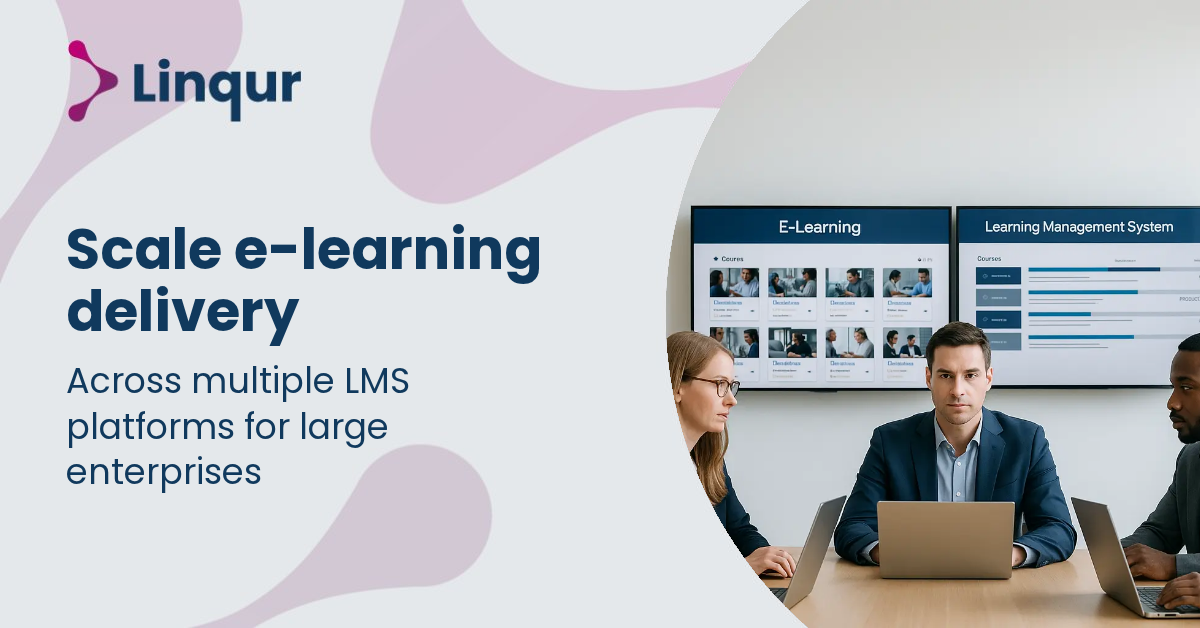
Large enterprises rarely operate on a single learning platform. One business unit may use a corporate LMS, another may rely on a regional platform, and external partners or customers may train in completely different systems. That creates a scaling problem that is not only about user volume. As both LMS scalability guidance and performance-focused planning point out, growth affects course catalog size, reporting needs, user roles, customisations, and platform performance at the same time. In practice, that means your challenge is not just serving 5,000 more learners, it is serving them consistently across different technical environments.
The biggest bottleneck is duplication. If you package, upload, test, and maintain the same course separately in each LMS, every update becomes a coordination project. Version drift appears quickly, completion rules vary, and support teams spend time troubleshooting local exceptions instead of improving the learning experience. This is why many enterprise teams now treat distribution as a separate infrastructure layer, rather than as something each LMS should handle on its own.
To scale e-learning multiple LMS environments successfully, you need to separate content ownership from content consumption. In other words, your organisation should manage the source of truth in one place, then deliver it into many platforms through standards-based connections. This is where Learning Tools Interoperability becomes especially useful. Instead of copying a course into every destination LMS, you can publish it centrally and let each LMS launch it as an external tool.
For enterprise distribution, that model matters because it keeps control over updates, access logic, and reporting closer to the content owner. Our LTI Provider Service follows this pattern by allowing centrally managed learning objects, including SCORM packages, files, videos, and complete learning paths, to be published into multiple external LMS platforms while management stays central. In a multi-client or multi-division setup, this reduces operational overhead and makes it easier to support different platform types without rebuilding the same course delivery flow each time.
Not every LMS ecosystem supports the same approach equally well, so it helps to think in layers. LTI is strong when you want a central platform to serve content into another LMS with launch, identity, and result exchange. SCORM is still widely accepted, which is why many organisations continue using it for compatibility, as reflected in the broad market support for SCORM-compatible LMS platforms. APIs become important when you need deeper automation around enrolments, catalog sync, or downstream business systems.
In reality, enterprises often need all three. A mature distribution layer can publish through LTI where supported, use SCORM-based delivery where needed, and connect operational workflows through APIs. If you are comparing approaches, content distribution via LTI, SCORM, or API is less about choosing one universal winner and more about matching the method to the receiving platform and the business process around it.
A scalable multi-LMS architecture usually includes a central content repository, a standards-based delivery layer, identity handling, and a reporting model that can aggregate data across destinations. This architecture supports the kind of distributed learning environments described in enterprise LMS discussions, where teams, partners, and regions all need access without losing consistency.
A practical design often includes:
This is also where product capabilities matter in a non-obvious way. If your delivery layer can maintain separate tool configurations per customer or LMS while still using the same underlying course, you can handle local branding, permissions, or rollout timing without multiplying content maintenance. If it also supports grade return and membership sync through modern LTI services, your reporting picture becomes more reliable across platforms.
Scaling delivery fails quickly when access is inconsistent. Learners are often moved between HR systems, LMS tenants, portals, and partner platforms. Each extra login step creates friction and support load. For enterprise rollouts, passwordless or automated access patterns can reduce this significantly, especially when paired with provisioning workflows. Our Magic Link Login and API-based automations are relevant here because they help connect entitlement and access without forcing users through unnecessary account recovery cycles. You can see the same operational logic in articles on automatic LMS login from CRM flows and e-learning automations with APIs.
If you are planning to scale across multiple LMS platforms, start by auditing where variation actually exists. List every LMS, the standards each one supports, how enrolment is handled, what reporting must come back, and who owns updates. Then classify your catalog. Some content can be delivered as a complete course, some as single learning activities, and some may need a fallback route for older systems. This is also why organisations reviewing SCORM dispatching at scale often end up combining methods instead of relying on one format alone.
Next, define governance. Decide who approves changes, how versions are released, and how exceptions are tracked per platform. Without that structure, even a strong technical setup can become messy as more clients, regions, and partner systems are added. Governance keeps the operating model stable when the delivery footprint expands.
Finally, pilot with a small number of high-value enterprise clients first. Big clients usually expose the real complexity: diverse LMS configurations, strict reporting expectations, and identity requirements. If your distribution layer works there, it is far more likely to hold up everywhere else.
Multi-LMS scale is not just a content problem. It is a distribution, identity, reporting, and governance problem that needs one coordinated architecture.
Start by auditing every LMS in your delivery landscape so you can map standards support, enrolment flows, reporting needs, and update ownership before scaling further.
If you put these foundations in place now, you will make your multi-LMS delivery more consistent, easier to maintain, and better prepared for growth.
Joris Even is our founder and the brains behind our products, with 15 years in e-learning. He loves the outdoors and lives to enjoy every moment. Joris’s easy-going approach and deep industry knowledge make our work both fun and impactful.
With our LTI Provider Service, you can integrate your content into any LMS. Fast, simple, and hassle-free. Get the brochure and find out how!
With SCORM Proxy, you can play SCORM courses in any LMS without worrying about updates or hosting. Sounds good? Request the brochure!
Our LTI Converter transforms SCORM into LTI, making your content work in any LMS. Want to know how? Download the brochure and find out for yourself!
With Magic Link Login, your users log in securely with just one click – no passwords, no hassle. Discover how in the brochure!
With the Linqur API, you can seamlessly connect e-learning systems and automate everything. Download the brochure and discover the benefits.