.jpeg)
When training providers or organisations try to track learner activity beyond traditional e-learning platforms, they often face confusion about which standard to use. SCORM has long been the go-to for packaging and tracking course content within LMSs, while LTI focuses on seamless integration and content launch across systems.
However, xAPI, also known as Tin Can API, introduces a new way to capture detailed learning experiences both online and offline, across multiple devices and environments. Understanding how xAPI compares to SCORM and LTI is important for choosing the right technology to meet your tracking and integration needs.
The Linqur API supports flexible data exchange, while solutions like our LTI Provider Service enable smooth content distribution across platforms.
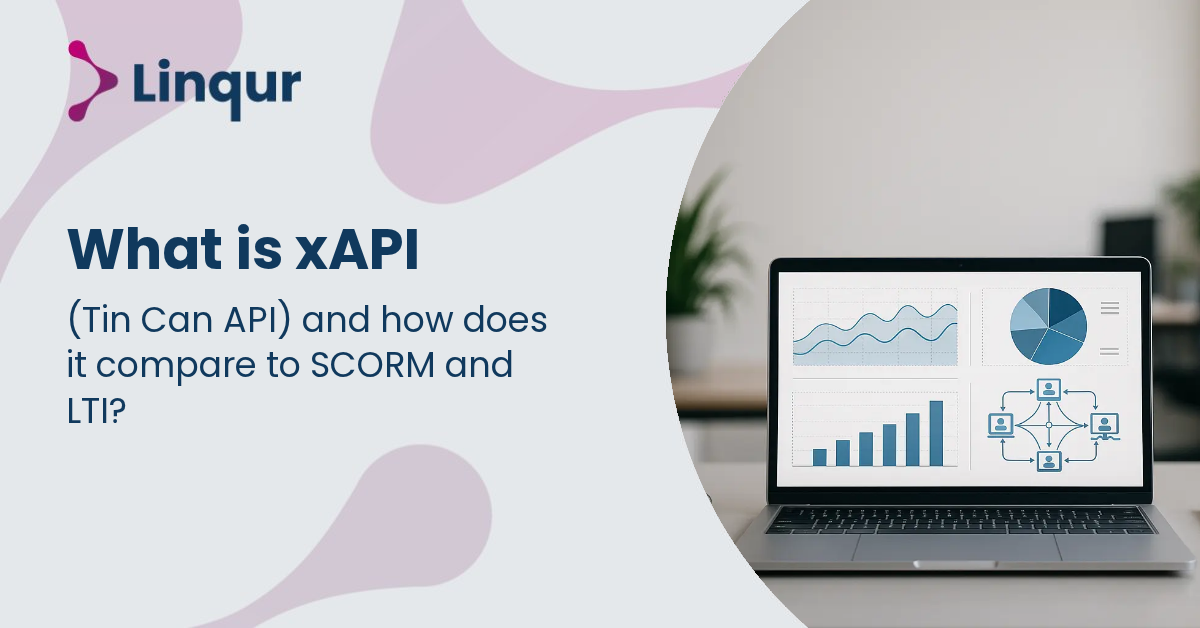
From the LMS perspective, the Experience API (xAPI) operates very differently from SCORM and Learning Tools Interoperability (LTI). SCORM relies on a tightly coupled runtime communication model where the content package is launched inside the LMS, and data such as completion status or scores are exchanged through specific runtime calls like LMSInitialize, LMSGetValue, and LMSSetValue. LTI, on the other hand, is a launch protocol that connects external tools to LMSs using OAuth and OpenID Connect for authentication, enabling seamless single sign-on and data exchange primarily at launch and grade reporting.
xAPI breaks this model by decoupling the learning activity from the LMS interface. Instead of runtime calls, xAPI uses statements in the form of "actor verb object" (e.g., "Jack completed safety training") sent asynchronously to a Learning Record Store (LRS). This means learning experiences can be recorded from any device or system, online or offline, and not just within an LMS. The LRS acts as a central data repository, receiving and storing these statements via RESTful API calls, typically using HTTP POST requests with JSON payloads. This allows tracking of a wide variety of learning experiences beyond traditional course completions, including simulations, mobile learning, and real-world activities.
Data Scope
With SCORM, you control data limited to course interactions within an LMS session. xAPI expands this to any learning experience, anywhere, anytime. LTI controls access and launch parameters but does not track detailed learning activity beyond launch and grade sync.
Content Delivery
SCORM packages must be uploaded and hosted in the LMS or a proxy. With xAPI, content delivery is flexible; learning can happen outside the LMS, and only statements are sent back. LTI controls tool launches but content stays external.
Reporting Flexibility
SCORM reporting is constrained to predefined data models. xAPI lets you define custom verbs and activities, capturing granular data for advanced analytics. LTI supports grade sync and membership but not detailed activity tracking.
Integration Complexity
SCORM requires LMS runtime support and package management. xAPI requires an LRS and API integration but allows more loosely coupled systems. LTI focuses on secure tool launch and user identity federation.
Our Linqur API supports xAPI data integration, enabling you to automate data flows and reporting across systems. For SCORM content distributed remotely, our SCORM Proxy manages package hosting and tracking. For LTI, our LTI Provider Service centralizes tool publication and reporting across multiple LMSs.
Consider a corporate training provider who wants to track not only course completions but also informal learning such as attending webinars, reading documents, or participating in simulations. SCORM alone cannot capture these diverse activities because it requires the learner to launch SCORM packages inside an LMS and only tracks predefined data points.
Using xAPI, the provider can capture all these experiences as statements sent to an LRS. For example, a learner attending a virtual reality safety simulation can have their interactions recorded with precise timestamps and context. The provider can then analyze this data to tailor follow-up training.
However, if the provider needs to distribute standardized SCORM courses to multiple client LMSs without losing control over updates and reporting, using our SCORM Proxy to remotely host and track SCORM packages is practical. For seamless integration of external tools or content libraries into client LMSs with single sign-on and grade synchronization, an LTI connection managed through our LTI Provider Service is ideal.
This reflects the operational reality that "convert SCORM to LTI" often means "keep the course, change the delivery model," while xAPI opens new data and experience horizons.
How does xAPI affect latency in learning data reporting?
xAPI statements are sent asynchronously to the LRS, which means data reporting is near real-time but not instantaneous. Network conditions and LRS performance affect latency. Unlike SCORM’s synchronous runtime calls, xAPI allows offline data capture, syncing later when connectivity is restored.
Is xAPI compatible with all LMS platforms?
Not all LMSs natively support xAPI. Many popular platforms like Moodle, Canvas, and Blackboard have varying levels of xAPI support or require plugins. Using an external LRS and API integration, such as with our Linqur API, can bridge gaps in native LMS support.
What are the IT security considerations for using xAPI?
xAPI data travels over secure HTTPS connections and requires authentication to the LRS. Data privacy and compliance depend on how the LRS is hosted and managed. Our solutions operate on ISO 27001 certified infrastructure, and we support GDPR-compliant data handling, but you must ensure your LRS and integrations meet your organization's security policies.
xAPI beats SCORM when you need to track learning beyond the LMS or traditional courseware. It excels in capturing informal, offline, and experiential learning, offering richer data for analytics and adaptive learning. SCORM remains valid for standardized, LMS-hosted courseware where interoperability and simplicity matter.
Compared to LTI, xAPI is not a launch protocol but a data specification. Use LTI when your priority is seamless tool integration, single sign-on, and basic grade reporting within LMSs. Use xAPI when your priority is detailed learning data collection from multiple sources and devices.
In many cases, a combined approach works best. For example, use LTI to launch tools and xAPI to capture detailed learning data from those tools. Our LTI Converter helps bridge SCORM packages into LTI delivery, while our infrastructure supports all three standards to fit your operational needs.
For a deeper understanding of these choices, our article on content distribution with LTI, SCORM, or API provides a detailed decision framework. Also, see our blog on managing and updating SCORM packages at scale for operational insights on SCORM, and why more customers are asking for an LTI connection reflecting the evolving market trends.
xAPI redefines learning data as a continuous stream of experiences rather than discrete course events tied to an LMS session.
Explore how our Linqur API can help you unify xAPI data flows with your existing LMS and reporting systems.
Start capturing richer learning data by integrating xAPI with your current LMS setup in under an hour. Book a 30 minute session with one of our engineers to see how our Linqur API can streamline your xAPI adoption.
Joris Even is our founder and the brains behind our products, with 15 years in e-learning. He loves the outdoors and lives to enjoy every moment. Joris’s easy-going approach and deep industry knowledge make our work both fun and impactful.
With our LTI Provider Service, you can integrate your content into any LMS. Fast, simple, and hassle-free. Get the brochure and find out how!
With SCORM Proxy, you can play SCORM courses in any LMS without worrying about updates or hosting. Sounds good? Request the brochure!
Our LTI Converter transforms SCORM into LTI, making your content work in any LMS. Want to know how? Download the brochure and find out for yourself!
With Magic Link Login, your users log in securely with just one click – no passwords, no hassle. Discover how in the brochure!
With the Linqur API, you can seamlessly connect e-learning systems and automate everything. Download the brochure and discover the benefits.