What is Learning Tools Interoperability (LTI) and why does it matter for L&D?
When a learning and development team tries to integrate new digital tools into their existing LMS, they often encounter a confusing landscape of incompatible systems and manual workarounds. The challenge is not just about adding content; it is about connections that let tools and platforms communicate securely and efficiently.
Learning Tools Interoperability (LTI) is the technical standard designed to solve this problem by enabling different learning applications to work together within any LMS environment. Understanding LTI is important because it transforms how content is delivered and managed, reducing complexity and improving the learner experience.
The LTI Provider Service is built to leverage this standard, helping you publish and control content centrally while integrating smoothly with multiple platforms.
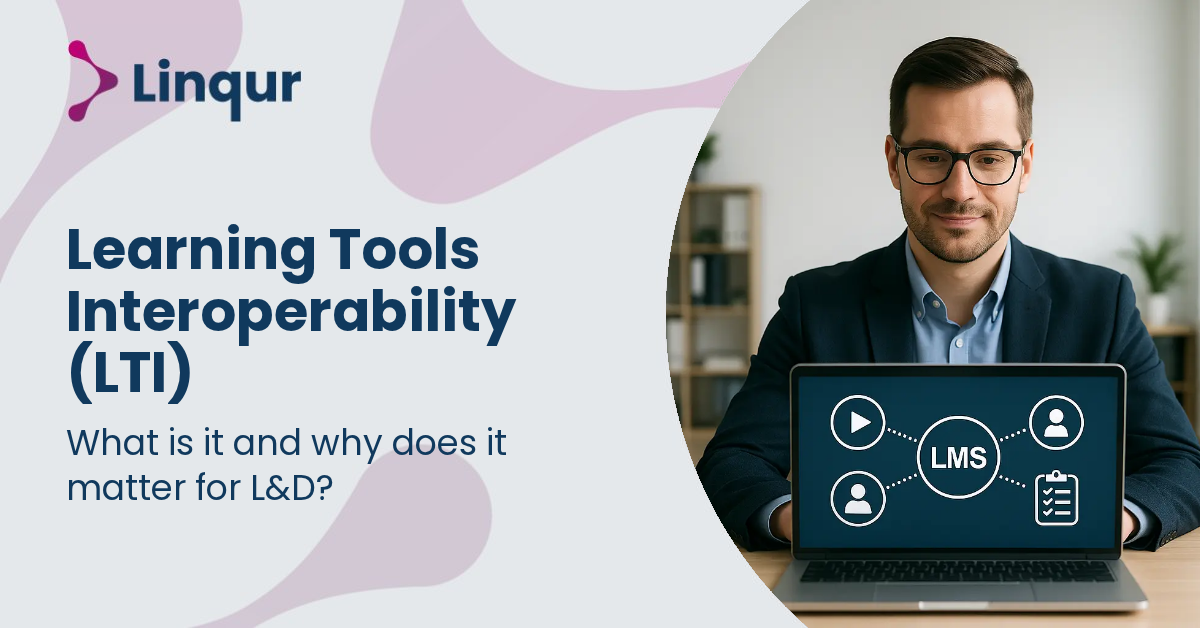
How Learning Tools Interoperability Actually Works
From the LMS perspective, Learning Tools Interoperability (LTI) is a standardised protocol for launching external learning tools and content into the LMS environment without requiring separate logins. When a user launches an LTI tool, the LMS sends a launch request containing user information, course context, and security credentials to the external tool provider. This request typically uses OAuth 1.0a in LTI 1.1 or OAuth 2.0 with OpenID Connect and JSON Web Tokens in LTI 1.3, ensuring secure authentication and data exchange.
From your perspective as a training provider or course vendor, LTI allows you to host your content on your platform while enabling users to access it directly from their LMS. The launch process involves a series of steps: the LMS sends a signed launch message to your tool’s launch URL, including parameters like user role, course ID, and resource link ID. Your tool validates the request, authenticates the user, and then delivers the content or service. This interaction can also include services like Assignment and Grade Services (AGS) for grade synchronization and Names and Roles Provisioning Services (NRPS) for user role synchronization, which are part of LTI Advantage.
What You Control With LTI Integration
- Centralized Content Management You maintain control over your learning content on your platform, enabling updates and changes without requiring repackaging or redistribution.
- Access and Permissions You define who can access your content based on roles and enrollments passed securely from the LMS, allowing precise access control.
- User Experience Consistency You control the tool interface and experience, while users get single sign-on and can move straight in from their LMS.
- Data Exchange and Reporting You manage the flow of data such as grades and completion status back to the LMS, ensuring that learner progress is accurately tracked and reported.
- Security and Compliance You implement and enforce security protocols like OAuth 2.0 and OpenID Connect to protect user data and comply with institutional policies.
Choosing Between LTI Versions and Implementation Scenarios
Consider a corporate training provider integrating with multiple LMS platforms like Moodle, Canvas, and Blackboard. Supporting both LTI 1.1 and LTI 1.3 ensures broad compatibility while leveraging modern security features where available.
For example, using our LTI Provider Service, you can publish SCORM packages, videos, and full learning paths to external LMSs without losing control over content updates or reporting. This service supports deep linking, allowing learners to launch specific content items directly, and supports AGS and NRPS to synchronize grades and user roles dynamically.
In contrast, if you primarily distribute SCORM content and need to support legacy LMSs without LTI, a SCORM Proxy can provide remote SCORM course dispatch and management. However, LTI offers a more streamlined, secure, and scalable integration model for modern learning ecosystems.
Common Questions
How does LTI affect latency and user experience during content launch? LTI launches are typically quick because the LMS sends a signed launch request to the external tool, which then authenticates and delivers content. Network latency depends on the hosting infrastructure of the tool provider. Using robust services like our LTI Provider Service ensures minimal delay and smooth user experience.
What uptime guarantees are typical for LTI tool integrations? Uptime depends on the tool provider’s infrastructure. Reliable LTI implementations use cloud hosting with redundancy and monitoring. Our infrastructure is designed for high availability to minimize downtime and ensure continuous access.
How secure is user data when transmitted via LTI? LTI 1.3 uses OAuth 2.0 and OpenID Connect, which are strong security protocols for authentication and data exchange. Data is transmitted over HTTPS, and sensitive information is protected by token-based authentication. However, security also depends on proper implementation and configuration by both LMS and tool providers.
When LTI Beats SCORM or API Integration
LTI is often the best choice when you want to maintain centralized content control while providing access across multiple LMS platforms. It reduces the overhead of packaging and dispatching content repeatedly and supports dynamic user and grade synchronization.
However, SCORM remains relevant if you need offline tracking or LMS-native content execution without external tool dependencies. APIs can offer more granular control and integration possibilities but require more development effort and maintenance.
For instance, a training vendor distributing courses to clients with diverse LMSs will benefit from LTI’s standardized launch and reporting model, avoiding the complexity of multiple SCORM dispatches or custom API integrations. Our article on content distribution with LTI, SCORM, or API explores this decision context in detail.
This technical and operational understanding of LTI shows why it matters for learning and development teams aiming to expand offerings, improve learner experience, and streamline content management across platforms. For deeper insights, our blog on LTI integration challenges in real projects and upgrading from LTI 1.1 to LTI 1.3 provide practical guidance.
Take aways
LTI transforms content delivery from a static file exchange into a live, secure handshake between platforms that you control.
- If your content must serve multiple LMSs with varying LTI versions, supporting both LTI 1.1 and 1.3 ensures maximum reach without sacrificing security.
- If you want to reduce support tickets related to user access and enrollment, leveraging LTI’s role and context parameters can automate permissions dynamically.
- If your reporting needs include real-time grade synchronization, adopting LTI Advantage services like AGS can eliminate manual data reconciliation.
- If you face challenges maintaining SCORM packages across clients, shifting to LTI-hosted content lets you update once and deliver everywhere instantly.
- If your security requirements are evolving, moving to LTI 1.3 with OAuth 2.0 and OpenID Connect future-proofs your integrations against emerging compliance demands.
Explore how our LTI Provider Service can help you implement these capabilities with minimal overhead.
publish once, launch everywhere
Start by connecting your content to a test LMS using our LTI Provider Service and see how quickly you can launch a secure learning experience, usually within 30 minutes. Book a 30 minute LTI walkthrough with one of our engineers, or read the setup documentation to start in self-service mode.
Related articles
SCORM Proxy vs SCORM Cloud Dispatch: what is the difference?
When training providers distribute SCORM content to multiple clients, managing separate SCORM packages for each LMS quickly becomes overwhelming. Every update means sending out new files, tracking versions, and hoping clients upload the latest release correctly.

The benefits of becoming an LTI provider for your training business
If you have ever tried to expand your training business by integrating your courses into multiple learning management systems, you already know how complex and fragmented the process can be.
What is xAPI (Tin Can API) and how does it compare to SCORM and LTI?
When training providers or organisations try to track learner activity beyond traditional e-learning platforms, they often face confusion about which standard to use.
About the author
Joris Even is our founder and the brains behind our products, with 15 years in e-learning. He loves the outdoors and lives to enjoy every moment. Joris’s easy-going approach and deep industry knowledge make our work both fun and impactful.